

? Are you ready to cut energy bills, improve comfort, and make your HVAC system work smarter rather than harder?
Practical Approaches to energy efficient hvac Design and Operation
This article gives you a thorough, practical guide to designing and operating energy-efficient HVAC systems. You’ll find design principles, operational strategies, retrofit priorities, and actionable checklists to help you reduce energy consumption while maintaining occupant comfort.
Why energy-efficient HVAC matters
Your HVAC system typically accounts for a major portion of a building’s energy use and operating costs. By optimizing HVAC design and operation, you improve comfort, lower utility bills, reduce greenhouse gas emissions, and extend equipment life.
Key principles of energy-efficient HVAC design
You want to aim for systems that deliver the required thermal comfort and indoor air quality with the least energy input. The following principles guide every efficient HVAC solution and help you prioritize decisions during design, selection, and operation.
Right-sizing and load-matching
Right-sizing means matching equipment capacity to the actual heating and cooling loads rather than oversizing for perceived safety. If you oversize, you’ll see reduced efficiency, more cycling, higher humidity, and shorter equipment life, so you should always use accurate load calculations.
Improve the building envelope first
A stronger envelope reduces the heating and cooling load you need to serve. Before selecting expensive systems, invest in insulation, air sealing, good glazing, and shading to lower the required HVAC capacity and energy use.
Choose the right system type for the application
Different systems perform better in different climates and building types. You should compare system types (packaged rooftop, VRF, VAV, heat pump, hydronic) based on load profile, control needs, and lifecycle costs.
Use efficient components and technologies
You’ll want high-efficiency compressors, ECM/PM motors for fans and pumps, ASHRAE-compliant coils, and properly sized heat exchangers. These components deliver improved efficiency and better part-load performance.
Optimize ventilation and indoor air quality
Ventilation is essential for health, and you can control it efficiently with demand-controlled ventilation (DCV), energy recovery ventilators (ERV), and dedicated outdoor air systems (DOAS). These reduce the energy penalty for fresh air while preserving IAQ.
Implement advanced controls and analytics
Smart controls, scheduling, setpoint optimization, and fault detection significantly reduce wasted energy. You should use building automation systems (BAS) and analytics to continuously tune the HVAC system for peak performance.
Commission, retrocommission, and verify performance
Commissioning ensures systems meet design intent, while continuous commissioning and monitoring maintain efficiency over time. You should plan commissioning during design and retrocommissioning for existing buildings to capture savings opportunities.
HVAC system types and efficiency comparison
You should choose the system that best fits your building’s load profiles, occupancy patterns, and climate. The table below compares common system types to help you decide.
| System Type | Best Use Cases | Efficiency Characteristics | Pros | Cons |
|---|---|---|---|---|
| Packaged Rooftop Units (RTUs) | Small–medium commercial | Moderate efficiency; easier upgrades | Low first cost; modular | Frequent cycling; limited part-load efficiency |
| Variable Air Volume (VAV) with Central Plant | Large office buildings | High efficiency with proper controls | Good part-load performance; centralized maintenance | Complex controls; higher initial cost |
| VRF/VRV Heat Pump Systems | Medium–large office, multifamily | Excellent part-load efficiency; simultaneous heating/cooling | Zoning flexibility; high COPs | Higher equipment cost; refrigerant handling |
| Split Systems (Residential) | Single-family, small spaces | Moderate to high efficiency depending on equipment | Low cost; easy replacement | Limited zoning; duct losses |
| Water-Source Heat Pumps / Hydronic | Campus, high-rise | High efficiency when plant is optimized | Efficient heat distribution; thermal storage compatible | Complex plant management; pumps required |
| DOAS + Terminal Systems | Buildings with high ventilation needs | Efficient ventilation and humidity control | Separates latent and sensible control; improves IAQ | Requires careful integration |

Load calculation and right-sizing
You should start every design with an accurate load calculation. Proper load estimation avoids oversizing and identifies peak and part-load demands critical to efficient system selection.
- Use current standards: ASHRAE Handbook, ACCA Manual J (residential), Manual N (commercial) or equivalent software.
- Include internal gains, occupancy schedules, lighting, equipment, infiltration, solar gains, and envelope properties.
- Account for part-load conditions and diversity factors rather than sizing to extreme peak conditions unless required by code.
Common mistakes to avoid:
- Using rule-of-thumb sizing instead of detailed loads.
- Ignoring air infiltration and internal heat gains.
- Relying on outdated envelope data or construction assumptions.
Building envelope and its role
Your building envelope is the first line of defense for reducing HVAC loads. Improving insulation, windows, air sealing, and shading yields some of the most cost-effective energy savings and can reduce the size and cost of HVAC equipment.
Insulation and thermal mass
Increase insulation in walls, roofs, and floors to lower conductive heat transfer. You should choose insulation levels based on climate and code requirements, and consider thermal mass where beneficial for diurnal temperature swings.
Air sealing and infiltration control
Air leakage is a major source of uncontrolled heating and cooling loads. You should seal gaps, use continuous air barriers, and ensure proper detailing at penetrations to reduce infiltration and associated HVAC energy penalties.
Glazing, shading, and high-performance windows
High-performance glazing can reduce solar heat gain in hot climates and heat loss in cold climates. You should pair glazing with shading devices and low-e coatings to tailor solar control by orientation.
| Envelope Measure | Typical Impact | Relative Cost | Priority |
|---|---|---|---|
| Improved insulation (walls/roof) | Reduces heating/cooling load 10–30% | Low–Medium | High |
| Air sealing and pressure control | Lowers infiltration losses 5–20% | Low | High |
| High-performance windows | Reduces solar/heat loss 5–15% | Medium–High | Medium |
| Exterior shading / solar control | Reduces cooling load in summer | Low–Medium | Medium |
Efficient equipment selection and metrics
You’ll want to evaluate equipment using standardized efficiency metrics and focus on part-load performance. Selecting high-efficiency equipment pays off over the lifecycle, especially when combined with controls and right-sizing.
Common efficiency metrics
- COP (Coefficient of Performance): Ratio of heating or cooling output to electrical input. Higher is better.
- EER (Energy Efficiency Ratio): Cooling capacity divided by power input at a specific test point.
- SEER (Seasonal Energy Efficiency Ratio): Seasonal average cooling efficiency.
- HSPF (Heating Seasonal Performance Factor): Seasonal heating efficiency for heat pumps.
- IEER/IEER2: Part-load efficiency metrics for chillers and packaged equipment.
You should compare equipment using full-season metrics where available and prioritize technologies with strong part-load performance.
Fans, pumps, and drives
Motors and drives influence system efficiency significantly. You should specify electronically commutated motors (ECMs) or premium-efficiency motors with variable frequency drives (VFDs) to optimize speed and reduce energy use.
Advanced system designs and strategies
When you want high efficiency at the design stage, consider advanced systems and architectures that improve part-load performance and ventilation efficiency.
Variable air volume (VAV) systems
VAV adjusts airflow to meet zone loads and is highly efficient in variable-load buildings. You should use VAV to reduce fan energy and match airflow to the actual demand.
Dedicated outdoor air systems (DOAS) and ERV/HRV
DOAS combined with energy recovery ventilators (ERVs) or heat recovery ventilators (HRVs) provide controlled ventilation while recovering energy from exhaust air. You should use DOAS where ventilation and humidity control are critical to efficiency and IAQ.
Variable refrigerant flow (VRF) systems
VRF systems offer high part-load efficiency and zoning flexibility by modulating refrigerant flow. You should consider VRF for buildings needing precise zone control and for retrofit situations with limited space.
Heat recovery and thermal storage
Heat recovery within mechanical systems (heat wheels, plate exchangers, run-around coils) captures energy that would otherwise be exhausted. Thermal storage (chilled water, ice) shifts cooling load to off-peak hours and can reduce peak plant capacity and demand charges.
Controls and building automation systems (BAS)
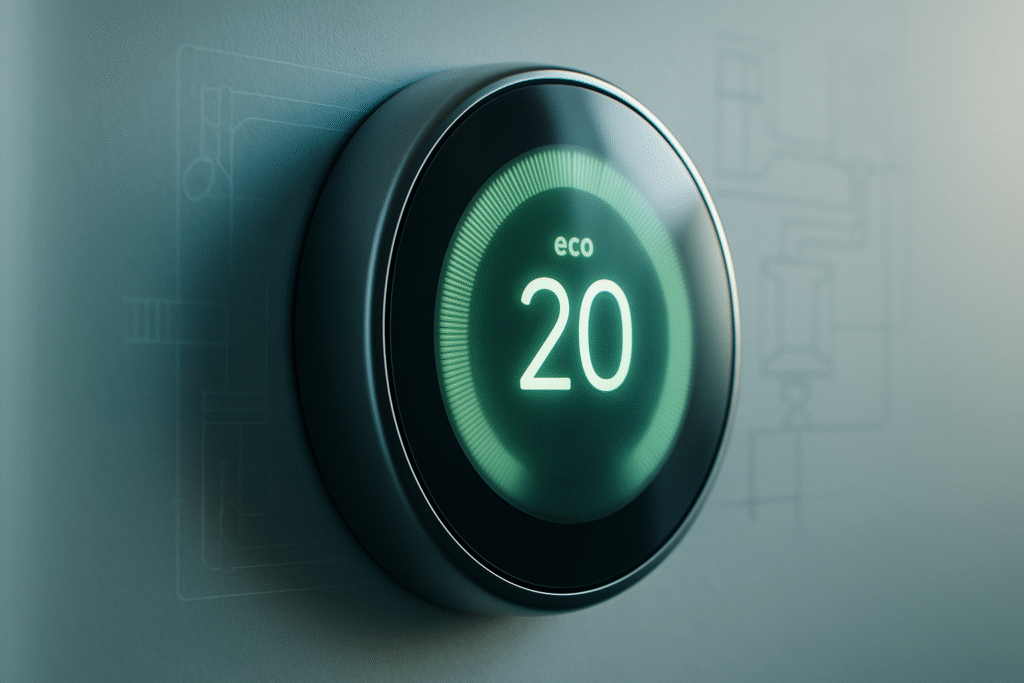
You can realize substantial savings with well-planned controls. A BAS ties equipment together, sequences operations, and implements strategies such as setback/schedule, DCV, and economizer control.
Scheduling and setbacks
Use occupancy schedules and setbacks to reduce conditioning during unoccupied hours. You should avoid extreme setback setpoints that cause long recovery runs, and prefer predictive re-occupancy control when possible.
Demand-controlled ventilation (DCV)
DCV adjusts outdoor air ventilation based on occupancy (CO2 sensors or people counts). You should apply DCV in variable-occupancy spaces to avoid over-ventilation and energy waste.
Economizer strategies
Economizers use cool outside air for free cooling when conditions allow. You should implement proper lockouts, sensor calibration, and enthalpy controls to avoid bringing in humid or polluted air improperly.
Fault detection and diagnostics (FDD)
FDD tools alert you to performance issues like sensor drift, fouled coils, and control failures. You should combine automated FDD with a maintenance plan to capture energy losses early.
| Control Strategy | Benefit | Implementation Complexity | Typical Savings |
|---|---|---|---|
| Scheduling & setbacks | Reduces run hours | Low | 5–20% |
| DCV | Reduces ventilation energy | Medium | 10–30% in variable spaces |
| Economizer | Free cooling | Medium | 5–25% |
| VSDs on fans/pumps | Improves part-load efficiency | Medium | 10–50% (depends on duty) |
| FDD | Early fault identification | Medium–High | 5–15% through prevention |
Commissioning, retrocommissioning, and continuous commissioning
You should plan commissioning as an integral part of design and construction. Proper commissioning verifies systems operate as intended, and retrocommissioning identifies efficiency opportunities in existing buildings.
- New construction commissioning ensures systems meet design intent, test sequences, and documentation.
- Retrocommissioning focuses on optimizing existing systems and recovering lost efficiency.
- Continuous commissioning (ongoing) uses BAS data and analytics to maintain performance over time.
Commissioning findings often yield cost-effective operational savings and comfort improvements.
Operation and maintenance best practices
Routine maintenance is crucial to sustain efficiency. You should implement a structured preventive maintenance program to avoid degradation and capture savings.
Regular maintenance tasks
- Replace or clean filters on schedule to reduce fan energy and maintain IAQ.
- Clean coils and condensate lines to preserve heat transfer and prevent microbial issues.
- Inspect belts, pulleys, and bearings; adjust and lubricate as required.
- Verify calibration of sensors and thermostats regularly.
Seasonal checks and plant optimization
- Pre-season tune-ups for heating and cooling seasons keep systems ready and efficient.
- Chiller plant optimization: reset condenser water temperature, optimize chilled water supply, and sequence chillers for efficient part-load operation.
- Condensing boilers and heat pump checks: verify setpoints, control logic, and flow rates.
| Maintenance Task | Frequency | Why it matters |
|---|---|---|
| Filter change/clean | 1–6 months | Reduces pressure drop and energy use |
| Coil cleaning | Annually or as needed | Restores heat transfer |
| Vibration & bearing check | Annually | Prevents failures and losses |
| Sensor calibration | Annually | Ensures correct control decisions |
| BAS backup & update | Annually | Preserves control logic and data |
Measurement and verification (M&V)
You should measure performance to confirm savings and inform future improvements. M&V provides the data needed to evaluate project success and supports incentive claims.
- Use metering at relevant points: system energy, chilled/hot water flows, outdoor air energy, and submetering for major loads.
- Apply recognized M&V protocols such as IPMVP to quantify savings and establish baselines.
- Track key performance indicators (KPIs): energy use intensity (EUI), HVAC-specific kWh, demand peaks, coefficient of performance, and system runtimes.
Retrofits and upgrades: prioritization and ROI
When you tackle upgrades, prioritize measures with short paybacks and high impact. You should run a simple cost-benefit and payback analysis to rank projects.
| Retrofit Measure | Typical Cost Range | Typical Payback | Typical Savings |
|---|---|---|---|
| VSDs on fans/pumps | Low–Medium | 1–3 years | 10–50% on motor energy |
| High-efficiency rooftop replacement | Medium | 3–7 years | 10–30% total HVAC energy |
| Heat recovery (ERV/HRV) | Medium | 2–6 years | 10–30% ventilation energy |
| Chiller plant controls optimization | Low–Medium | <2–4 years< />d> | 10–40% chiller energy |
| Building envelope upgrades | Medium–High | 3–10 years | 10–30% total building energy |
You should also consider non-energy benefits like improved comfort, IAQ, and reduced maintenance costs when prioritizing projects.
HVAC strategies by climate
Your design and operational choices should reflect climate-specific needs. The strategies below present high-level guidance for different climate zones.
Hot-humid climates
You should focus on dehumidification, controlling latent loads, and minimizing solar gains. DOAS with ERV, tight humidity control, and properly sized equipment are essential.
Hot-dry climates
You’ll want to prioritize sensible cooling and evaporative or indirect evaporative cooling where appropriate. High thermal mass, shading, and efficient distribution systems work well here.
Cold climates
You should emphasize insulation, air sealing, and minimizing infiltration. High-efficiency heat pumps, condensing boilers, and heat recovery systems are effective in reducing heating energy.
Mixed climates
You need strategies that handle both heating and cooling efficiently, such as heat pumps with backup heat, DOAS for ventilation control, and flexible controls to shift between economizer and mechanical modes.
Financing, incentives, and codes
You can leverage incentives and financing to reduce upfront costs and accelerate paybacks. You should look for utility rebates, government tax credits, and energy-efficiency financing programs.
- Check local utility incentive programs for equipment rebates, retrocommissioning, and custom incentives.
- Explore financing options such as energy service agreements, on-bill financing, or green loans to spread costs.
- Ensure compliance with current energy codes (IECC, ASHRAE 90.1) and consider certification programs (LEED, ENERGY STAR) for added recognition.
Realistic case examples
Below are short examples to help you visualize how strategies combine in practice.
Example 1 — Small office building (10,000 ft²)
You should start with envelope sealing and increasing insulation, then replace old RTUs with high-efficiency units with VFDs and economizers. Add DOAS for ventilation and implement BAS scheduling and DCV. Expected energy savings: 25–40% with payback ~3–6 years depending on incentives.
Example 2 — Medium retail space (50,000 ft²)
You should replace aged packaged units, add VSDs to supply fans, install an ERV for ventilation, and implement night setback and optimal start controls. Commissioning will ensure sequence optimization. Expected savings: 20–35% overall with reduced peak demand.
Example 3 — Large office tower with central plant
You should optimize the chilled water plant with variable-primary flow or hybrid systems, sequence chillers for part-load efficiency, and implement thermal energy storage to reduce peak demand. Add DOAS for ventilation and advanced BAS analytics for FDD. Expected savings: 30–50% in HVAC-related energy depending on baseline inefficiencies.
Practical implementation checklist
Use this checklist to move from planning to action in a structured manner. You should track each step to ensure outcomes.
- Perform an energy audit and load calculation.
- Prioritize envelope improvements and low-cost measures.
- Specify efficient equipment with strong part-load performance.
- Implement advanced controls (scheduling, DCV, economizers).
- Commission new systems and retrocommission existing systems.
- Set up M&V and KPIs to track improvements.
- Implement a preventive maintenance program tied to BAS alerts.
- Seek incentives and consider financing options.
- Reassess annually and use FDD for continuous optimization.
Conclusion and next steps
You now have a comprehensive framework for designing and operating energy-efficient HVAC systems. Start by assessing your current systems with a proper audit, focus on envelope and controls, select efficient equipment, and commit to commissioning and continuous monitoring. By following these practical approaches, you’ll reduce energy use, lower costs, and improve comfort—one step at a time.