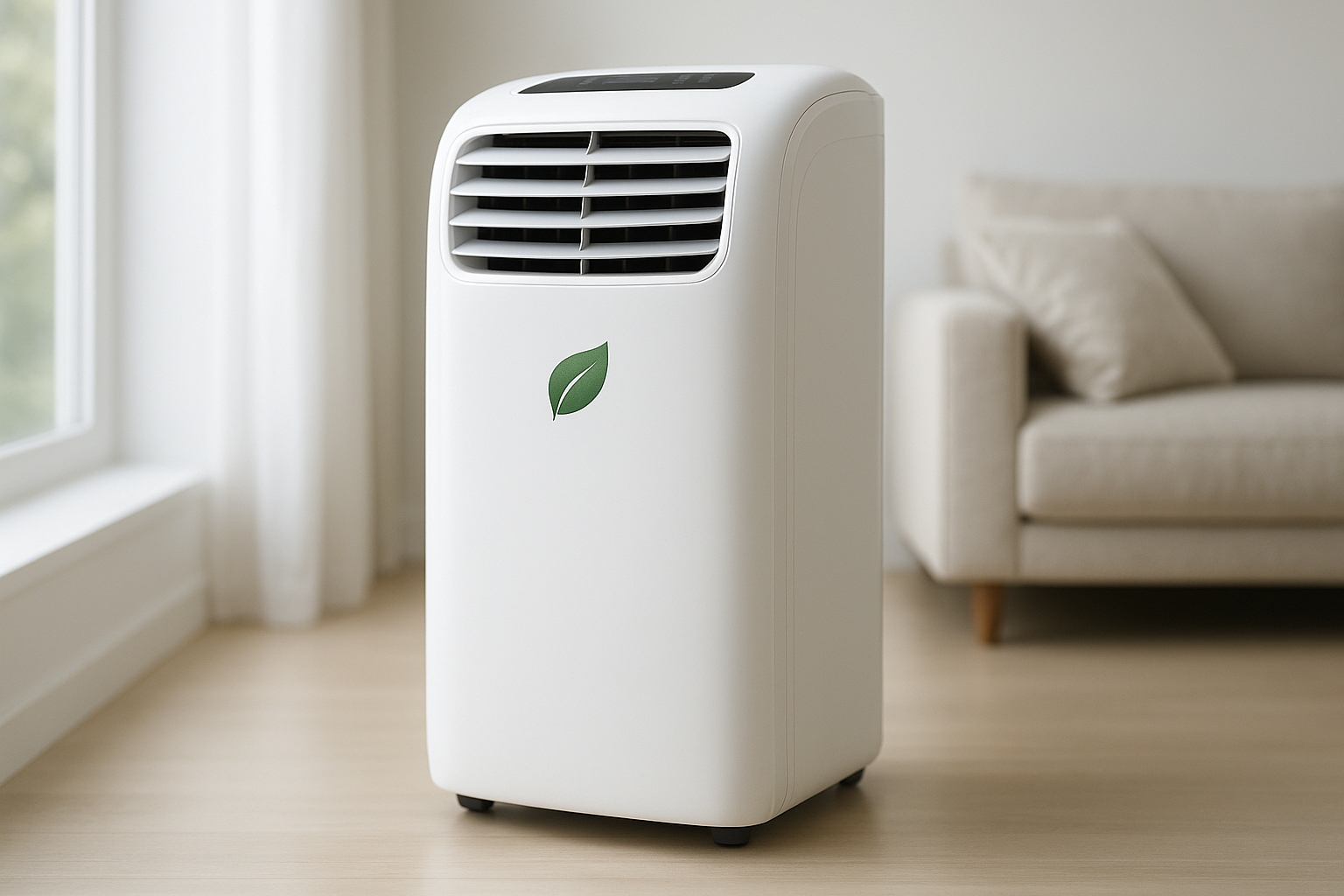
Looking for an energy-efficient portable air conditioner that keeps your space comfortable without blowing up your electricity bill?
Energy Efficient Portable Air Conditioner Buying Guide
This guide helps you choose a portable air conditioner that balances cooling performance, energy use, and convenience. You’ll find clear explanations of key terms, sizing guidance, efficiency calculations, feature recommendations, installation tips, and maintenance advice so you can buy with confidence.
Why choose a portable air conditioner?
Portable air conditioners give you flexible cooling without major installation work. You can move them from room to room, use them where window units aren’t possible, and store them during the off-season.
Portable units are especially useful if you rent, have limited window options, or want targeted cooling in areas like bedrooms, home offices, or apartments. They tend to be less expensive upfront than ductless mini-splits, though efficiency varies widely by model.

How portable ACs compare to other cooling options
Knowing how portable ACs stack up against window units and mini-splits helps you match performance to your needs. Each option has tradeoffs between cost, efficiency, installation, and aesthetics.
| Type | Typical Efficiency | Installation Difficulty | Typical Cost Range | Pros | Cons |
|---|---|---|---|---|---|
| Portable AC | Moderate (varies) | Easy | $250–$700+ | Mobile, no permanent install, good for renters | Less efficient than many window/mini-splits, louder |
| Window AC | Moderate–High | Moderate | $150–$600 | Often more efficient than portable, lower upfront cost | Requires suitable window, semi-permanent |
| Ductless Mini-Split | High | High (professional install) | $1,200–$4,000+ | Very efficient, quiet, zoned cooling | Higher upfront cost, professional install needed |
| Central AC | Varies | High | $3,000+ | Whole-house cooling, good efficiency if sized well | Major install and ductwork, expensive |
Key terms you should know
Understanding common terms helps you read labels and choose wisely.
- BTU (British Thermal Units): A measure of heat removal per hour. Higher BTU means more cooling capacity.
- EER (Energy Efficiency Ratio): BTU/h divided by watt input. Higher EER = better efficiency at a single operating point.
- CEER (Combined Energy Efficiency Ratio): A newer rating for room air conditioners including standby and off-mode energy; used for Energy Star requirements in portable models. Higher CEER = more efficient overall.
- Watts / kW: Electrical power used. Convert watts to kW by dividing by 1,000.
- Pints per day (dehumidification): How much moisture the unit can remove; useful if you live in humid climates.
- dB (decibel): Noise level. Lower dB is quieter.
- Self-evaporative / Continuous drain: Methods for handling condensate water.
Sizing your portable AC: matching BTU to room size
Getting the right size is crucial. Too small and the unit won’t cool effectively; too large and it will short-cycle, causing comfort and humidity issues. Use the table below as a basic guideline, then adjust for high ceilings, sun exposure, or many occupants.
| Room Size (sq ft) | Recommended BTU (Approx.) | Typical Use |
|---|---|---|
| Up to 150 | 6,000–8,000 | Small bedroom, office |
| 150–250 | 8,000–10,000 | Medium bedroom, small living room |
| 250–350 | 10,000–12,000 | Large bedroom, medium living room |
| 350–500 | 12,000–14,000 | Large living room or open-plan area |
| 500–700 | 14,000–18,000 | Large open areas, studio spaces |
Adjust the guideline:
- Add 10% BTU for rooms with high sun exposure.
- Add 600–800 BTU per additional person beyond two in the room.
- Increase for high ceilings (over 8 feet) proportionally.
- Reduce 10–20% for shaded rooms.
Single-hose vs dual-hose portable units
There are two main venting designs and they affect efficiency and performance.
Single-hose units
Single-hose units draw air from the room, cool it, and vent exhausted hot air outside. Because they create slight negative pressure, they can draw warm air from adjacent spaces, reducing efficiency.
- Best for: Short-term use, small spaces, lower cost.
- Drawback: Typically less efficient and may struggle in larger rooms.
Dual-hose units
Dual-hose units use one hose to draw air from outside to cool the condenser and another hose to exhaust hot air. This isolates the conditioned room from the intake airflow and usually improves efficiency and cooling speed.
- Best for: Larger rooms, longer runs, better energy performance.
- Drawback: Usually more expensive and slightly bulkier.
| Feature | Single-Hose | Dual-Hose |
|---|---|---|
| Efficiency | Lower | Higher |
| Installation | Easier | Similar complexity |
| Cooling speed | Slower | Faster |
| Cost | Lower | Higher |
Energy efficiency ratings explained
Understanding ratings helps you compare models and estimate operating costs.
- EER = BTU/h ÷ Watts. Measures efficiency at a steady-state condition. Higher is better.
- CEER is an improved metric for portable and room units that accounts for standby energy use and testing across modes. Energy Star uses CEER thresholds.
- COP (Coefficient of Performance) is another metric that’s dimensionless: cooling delivered divided by electrical energy input. The higher the COP, the more efficient.
Energy Star certification for portable ACs typically requires a CEER above a certain threshold (check current EPA requirements at purchase time), and certified units can save you money over the life of the product.
How to estimate running costs
You can estimate running costs with a simple formula:
- Calculate power draw in watts: Watts = BTU ÷ EER.
- Convert to kW: kW = Watts ÷ 1,000.
- Hourly cost = kW × electricity rate ($/kWh).
- Daily/monthly cost = hourly × hours per day × days.
Example comparison using a 10,000 BTU portable AC:
| Scenario | EER | Watts (approx) | kW | Cost/hr at $0.15/kWh | Cost for 8 hrs/day |
|---|---|---|---|---|---|
| Lower efficiency | 8 | 1,250 W | 1.25 kW | $0.1875 | $1.50/day |
| Mid efficiency | 10 | 1,000 W | 1.00 kW | $0.15 | $1.20/day |
| High efficiency | 12 | 833 W | 0.833 kW | $0.125 | $1.00/day |
Monthly cost (30 days) at 8 hrs/day:
- EER 8: $45
- EER 10: $36
- EER 12: $30
These are rough estimates. Real costs vary with room conditions, thermostat settings, fan speed, and ambient temperature.
Features to prioritize when buying
Knowing which features matter most helps you avoid paying for extras you won’t use and ensures you get the efficiency and convenience you need.
Energy and cooling features
- High EER or CEER rating: Prioritize higher values for lower energy bills.
- Dual-hose design: For larger rooms and better performance.
- Precise digital thermostat: Helps avoid overcooling and reduces runtime.
Convenience and comfort
- Programmable timer and sleep mode: Save energy by reducing runtime when you don’t need full cooling.
- Remote control and/or smartphone app: Useful if you run the unit from bed or another room.
- Auto mode or eco mode: Lets the unit adjust fan and compressor cycling for efficiency.
- Heater function (if needed): Some units offer heating for all-season use.
Noise and placement
- Low-noise design and fan speeds: Choose models with lower dB for bedrooms and offices.
- Compact footprint and casters: Easier to maneuver and store.
Water handling and maintenance
- Self-evaporative system: Minimizes manual draining in typical conditions.
- Continuous drain option: Lets you run a hose to a drain for humid climates.
- Washable or replaceable filters (HEPA/activated carbon optional): Improves air quality and simplifies upkeep.
Build quality and warranty
- Solid exhaust hose and window kit included: Saves cost and improves sealing.
- Reasonable warranty (1–3 years) and good customer support.
Noise: what to expect and how to compare
Noise matters, especially in bedrooms and workspaces. Portable AC noise is often higher than window units because internal components are inside the room.
| Noise Source | Typical dB Range | What it sounds like |
|---|---|---|
| Quiet room or library | ~30–40 dB | Very quiet |
| Portable AC low fan | 45–55 dB | Gentle hum, acceptable for many |
| Portable AC high fan | 55–70 dB | Noticeable, may interfere with sleep or calls |
| Vacuum cleaner | 70–80 dB | Loud, intrusive |
When comparing models, look for SPL (sound pressure level) listed in decibels at low/mid/high fan settings. Remember that perceived loudness doubles with roughly every 10 dB increase.
Installation and venting: practical steps
Most portable ACs require a window kit for the exhaust hose. Proper venting and sealing improve efficiency and reduce hot air infiltration.
Basic installation steps
- Position the unit near a window and a power outlet (avoid extension cords).
- Attach the exhaust hose to the unit per the manual.
- Install the window kit and attach the hose to it, sealing gaps.
- Level the unit slightly backward (if required) to allow condensate to flow to a drain or bucket.
- Test cooling and check for air leaks.
Tips for better performance
- Keep the exhaust hose as short and straight as possible; long bends reduce efficiency.
- Seal gaps around the window kit with weather stripping or foam to prevent warm air infiltration.
- Don’t place the unit close to heat sources or direct sunlight.
- If continuous drain is needed, route the hose to a floor drain or condensate pump.
Maintenance and common troubleshooting
Regular maintenance extends life and preserves efficiency. Troubleshooting helps you avoid unnecessary service calls.
Routine maintenance
- Clean or replace the filter every 2–4 weeks depending on use and air quality.
- Empty the condensate reservoir as needed unless using continuous drain or self-evap system.
- Clean the exterior and vents and vacuum the condenser coils annually (unplug first).
- Check the exhaust hose and window seal for cracks or gaps.
Common problems and fixes
- Unit doesn’t cool well: Check the filter, ensure vents are not blocked, confirm the exhaust hose is connected and not too long, and verify the BTU is adequate for the room.
- Unit cycles on and off rapidly (short-cycling): Ensure proper sizing and that the thermostat is not placed in a draft or direct sunlight.
- Excess water in bucket: Use continuous drain or check that self-evaporation is functioning; high humidity may overwhelm the system.
- Unit freezes: Turn off and allow to defrost; reduce fan speed or clean coils. Persistent freezing can indicate low refrigerant or airflow issues.
Refrigerants and environmental considerations
Most modern portable ACs use R-410A or other non-ozone-depleting refrigerants. When buying, check the refrigerant type and choose units that comply with current environmental standards. Avoid older units using outdated refrigerants that may be phased out.
Recycling and disposal: At end-of-life, have the refrigerant professionally recovered and the unit recycled per local regulations.
Comparing long-term costs and value
Consider both the purchase price and operating costs to evaluate value.
| Cost Component | Portable AC | Window AC | Mini-Split |
|---|---|---|---|
| Purchase price | Low–Moderate | Low–Moderate | High |
| Installation | DIY | DIY/Moderate | Professional |
| Energy use | Moderate–High | Moderate | Lower |
| Repair/maintenance | Moderate | Moderate | Moderate–High |
| Lifespan | 5–10 years | 8–12 years | 12–20+ years |
If you plan to cool a single room intermittently, a portable AC often offers the best balance of upfront cost and convenience. For whole-home or long-term efficiency, mini-splits are usually more economical despite higher initial costs.
Cost-saving tips while using a portable AC
You can reduce energy consumption and still stay comfortable.
- Set the thermostat to a reasonable temperature (around 24–26°C / 75–78°F when you’re home).
- Use timers and programmable schedules so the unit runs only when needed.
- Close doors and windows in the cooled room to avoid wasted output.
- Use curtains or blinds to block direct sunlight during hottest hours.
- Supplement cooling with ceiling or standing fans to increase perceived comfort and allow a higher thermostat setpoint.
- Seal gaps around the window vent to prevent infiltration of hot air.
- Regularly clean filters to maintain airflow and efficiency.
Shopping checklist
Use this concise checklist when you shop so you don’t miss important details.
- Choose correct BTU for your room size (consider sun, height, occupants).
- Compare EER or CEER ratings (higher is better).
- Decide between single-hose and dual-hose based on room size and efficiency needs.
- Check noise levels on low and high fan settings.
- Look for programmable timer, sleep/eco mode, and thermostat accuracy.
- Confirm exhaust hose length and included window kit compatibility.
- Verify condensate handling (self-evap vs drain).
- Inspect filter type and ease of cleaning or replacement.
- Check warranty length and customer reviews for reliability.
- Confirm refrigerant type and environmental compliance.
Portable AC vs window unit vs mini-split: quick decision guide
If you want a quick recommendation based on typical needs:
- You need temporary or mobile cooling; can’t modify windows or walls: choose portable.
- You have a suitable window and want a slightly more efficient, quieter option for less money: choose window AC.
- You want long-term, efficient, quiet zoned cooling and are willing to pay for installation: choose a mini-split.
Frequently asked questions (FAQs)
How do I know what BTU I need?
Measure your room square footage and consult the BTU table above. Adjust up for high ceilings, sun exposure, and occupants. If in doubt, choose a slightly higher BTU rather than undersizing.
Are portable ACs energy efficient?
Some models are efficient, especially those with higher EER/CEER and dual-hose designs. Check ratings and Energy Star certification where available.
Do portable ACs remove humidity?
Yes, most portable ACs remove humidity as they cool. Dehumidification capacity (pints per day) is often listed; in very humid climates you may need a dedicated dehumidifier or continuous drain setup.
Can I use an extension cord?
You should avoid extension cords for air conditioners due to amperage draw and safety. Plug the unit directly into a grounded outlet. If you must extend, use a heavy-duty extension cable rated for the unit’s amperage, but professional advice is recommended.
How noisy are portable ACs at night?
Noise varies by model; look for units with low dB ratings and a “quiet” or “sleep” mode. Expect levels typically between 45–65 dB depending on speed settings.
How often should I clean the filter?
Check and clean washable filters every 2–4 weeks in heavy use, less often in mild conditions. Replace disposable filters per manufacturer instructions.
Final buying strategy and recommendations
When choosing a portable air conditioner, prioritize the right size and efficiency rating first. After that, focus on features that improve comfort and lower runtime—programmable temperature control, sleep modes, and efficient condensate management. Dual-hose units are preferable for larger rooms or if you use the unit frequently, while single-hose units can be a budget-friendly option for occasional use.
Try to select a model with a strong CEER/EER, reliable brand reputation, and warranty support. Compare running cost estimates using the EER-based formula above to understand long-term expenses. Finally, plan for proper installation and maintenance to keep the unit running efficiently and quietly.
If you provide the room dimensions, window type, and where you plan to place the unit, you can get a specific BTU recommendation and a shortlist of energy-efficient models that fit your needs.