


? Are you ready to cool your home comfortably while keeping energy bills under control?
Guide to Energy Efficient Window Air Conditioners for Home Comfort
This guide explains how energy efficient window air conditioners work, how to choose the right model for your space, and how to get the best performance and savings throughout the year. You’ll find practical tips, clear calculations, and easy-to-follow maintenance advice so you can make informed decisions and enjoy a comfortable home.
Why choose an energy efficient window air conditioner?
You’ll get targeted cooling for individual rooms at a typically lower upfront cost than central air systems. Energy efficient models lower electricity use, reduce monthly bills, and produce less environmental impact. You’ll also gain flexibility—installing or removing a unit is much simpler than changing ductwork.
Who benefits most from window air conditioners?
If you cool a few rooms rather than an entire house, live in an apartment, or need supplemental cooling for a specific area, a window unit can be ideal. You’ll find these systems particularly useful for bedrooms, living rooms, home offices, and older homes without central ducting.
How window air conditioners work
Window air conditioners move heat from inside your room to the outside using refrigeration cycles, a compressor, condenser coil, expansion valve, and evaporator coil. You’ll notice cool air blowing into the room while heat and moisture get expelled outside.
Key components and what they do
You’ll find several parts that make cooling possible: the compressor pressurizes refrigerant, the condenser releases heat outdoors, the expansion valve drops refrigerant pressure, and the evaporator absorbs heat inside. Fans move air across coils so heat exchange happens efficiently.
Why design matters for efficiency
A well-designed unit balances airflow, coil surface area, compressor efficiency, and controls. You’ll get better performance when the unit has proper airflow, good insulating seals, and modern control features like variable-speed compressors.

Energy efficiency ratings and standards
Understanding the ratings helps you compare models and predict operating costs. You’ll want to focus on EER, CEER, and ENERGY STAR certification for window units.
EER and CEER explained
EER (Energy Efficiency Ratio) is the ratio of cooling capacity (in BTU/h) to power input (in watts) at a fixed outdoor temperature. CEER (Combined Energy Efficiency Ratio) expands on EER by accounting for standby and off-mode power—providing a more realistic efficiency measure for room air conditioners. Higher numbers mean better efficiency for both metrics.
ENERGY STAR and federal standards
Many efficient window units carry ENERGY STAR labels, which indicate they exceed minimum federal efficiency requirements. ENERGY STAR models often use advanced compressors, better heat exchangers, and improved controls to reduce energy use. You’ll sometimes find rebates or incentives for ENERGY STAR-certified units.
Choosing the right size (BTU) for your room
Sizing is crucial. If the unit is too small, you won’t reach comfortable temperatures; if it’s too large, the unit will short-cycle and leave the room humid. You’ll want to choose a unit based on room square footage and other factors like ceiling height, sun exposure, and insulation.
BTU guidelines by room size
The table below provides common recommendations to help you match BTU capacity to room size. These are general guidelines—adjust for room specifics as noted in the following sections.
| Room size (sq ft) | Recommended BTU (approx.) |
|---|---|
| Up to 150 | 5,000 |
| 150 – 250 | 6,000 |
| 250 – 350 | 8,000 |
| 350 – 450 | 10,000 |
| 450 – 550 | 12,000 |
| 550 – 700 | 14,000 |
| 700 – 1,000 | 18,000 |
Adjusting for conditions
If the room is very sunny, add about 10–20% more BTU. If the room is shaded or you have excellent insulation, you might step down slightly. For kitchens or rooms with many occupants, increase capacity to handle additional heat loads. You’ll also need larger units for higher ceilings.

Calculating energy use and operating cost
You’ll want to estimate how much powering a window unit will cost you. Use these simple calculations to compare models and plan your budget.
Basic conversion and formula
- Watts = BTU / EER
- kW = Watts / 1,000
- Cost per hour = kW × electricity rate ($/kWh)
- Daily cost = Cost per hour × hours used
- Monthly cost = Daily cost × days used
Example: If you choose a 10,000 BTU unit with an EER of 10 and you pay $0.15 per kWh:
- Watts = 10,000 / 10 = 1,000 W (1.0 kW)
- Cost per hour = 1.0 × $0.15 = $0.15
- Running 8 hours/day = $1.20/day
- Monthly cost (30 days) = $36.00
Comparing efficiency levels
The same 10,000 BTU unit with an EER of 8 would use:
- Watts = 10,000 / 8 = 1,250 W (1.25 kW)
- Cost per hour = 1.25 × $0.15 = $0.1875
- Running 8 hours/day = $1.50/day
- Monthly cost (30 days) = $45.00
By choosing the EER 10 model, you’d save about $9 per month at these conditions. Small improvements in EER/CEER can add up over a cooling season.
Inverter vs. non-inverter compressors
You’ll encounter two main compressor types: fixed-speed and inverter (variable-speed). Understanding the difference helps you choose for comfort and efficiency.
How inverter technology helps
Inverter compressors vary speed to match cooling demand. You’ll experience fewer on/off cycles, better humidity control, and lower average power consumption. In many situations, inverter window units are quieter and more efficient, particularly during low-to-moderate cooling loads.
When a non-inverter unit still makes sense
If your budget is tight or you need a basic solution for occasional use, a quality non-inverter model can work well. You’ll want to prioritize EER/CEER and features like timers and thermostats to optimize performance.

Key features that improve energy efficiency
Certain features directly improve the real-world efficiency of the unit. You’ll want to prioritize these when selecting a model.
Thermostats and smart controls
Programmable thermostats, sleep modes, and Wi-Fi controls let you reduce runtime and avoid unnecessary cooling. You’ll benefit from scheduling and remote control so the unit runs only when you need it.
Variable fan speeds and modes
Multiple fan speeds let you run the unit at lower, more efficient settings when full power isn’t needed. Dehumidification modes remove moisture with less cooling energy, improving comfort without overcooling.
Auto-restart and sensor placement
Auto-restart safely restores settings after power outages, while room sensors and adjustable louvers help direct cool air for even distribution. You’ll get more comfort with less wasted energy when airflow is targeted correctly.
Installation tips for peak efficiency
Proper installation prevents air leaks, ensures proper drainage, and maintains correct airflow. You’ll get better performance and longer unit life by following these steps.
Window measurements and mounting
Measure the window opening before buying the unit. You’ll need a secure sash lock or mounting bracket, foam seals to prevent air leakage, and support brackets for larger units. Ensure the unit sits slightly tilted toward the outside so condensate drains properly.
Electrical and safety considerations
Check the unit’s amperage and voltage requirements. You’ll typically use a dedicated 115V or 230V circuit for larger units. Avoid extension cords and power strips—use a proper outlet and consider an electrician if you’re unsure.
Sealing and insulation
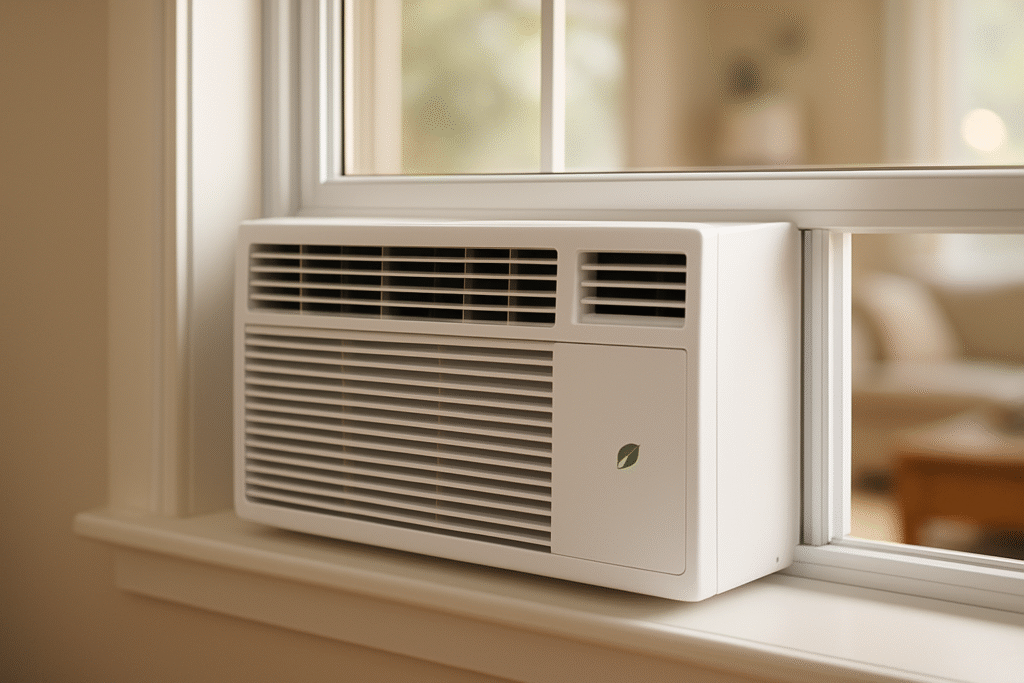
Seal gaps with foam or weatherstripping to stop warm air infiltration. You’ll improve efficiency significantly by stopping conditioned air from escaping and reducing outdoor heat gain.
Maintenance to keep efficiency high
Regular maintenance preserves cooling capacity and reduces energy consumption. You’ll extend the life of your unit while keeping performance steady.
Filter cleaning and replacement
Clean or replace filters every 1–3 months depending on use and air quality. You’ll notice better airflow and reduced strain on the compressor when filters are clean.
Coils, fins, and condenser care
Clean the evaporator and condenser coils annually to maintain heat transfer efficiency. Straighten bent fins with a fin comb and clear debris around the outdoor-facing side to ensure adequate airflow.
Off-season storage and inspection
Remove the unit if you live in an area with harsh winters, or cover and insulate it well. You’ll want to store remote controls and check seals before reinstalling in summer. A pre-season inspection catches refrigerant leaks and electrical issues early.
Troubleshooting common problems
You’ll be able to handle many issues yourself, and know when to call a professional.
Poor cooling or short cycling
If the unit isn’t cooling, check that the thermostat is set correctly, the filter is clean, and the unit is sized properly. Short cycling often indicates oversizing or low refrigerant.
Excessive noise or vibration
Loose mounting hardware, worn fan motors, or debris on the condenser can create noise. You’ll often fix this by tightening brackets, cleaning the unit, or replacing worn parts.
Water leaks
Leaks often mean improper tilt for drainage, blocked drain channels, or internal condensation problems. Confirm the unit slopes outward slightly and clear any obstructions before calling for service.
Comparing window air conditioners to other options
You’ll want to weigh upfront cost, installation complexity, efficiency, and comfort when choosing between window units, portable ACs, and mini-splits.
Window AC vs. portable units
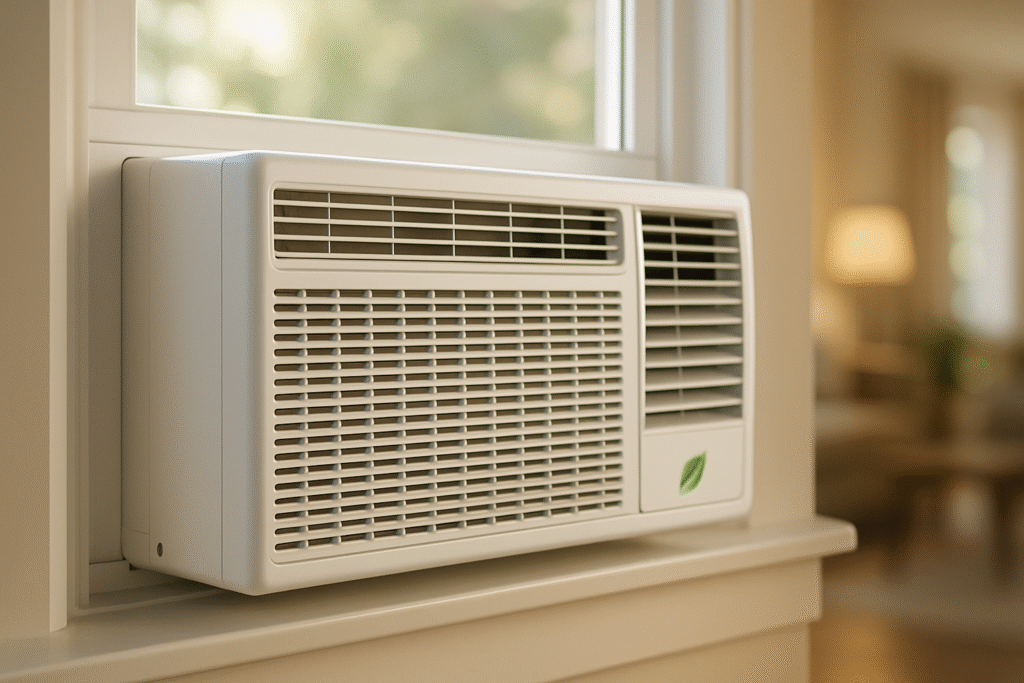
Window units typically deliver better energy efficiency and quieter operation than portable ACs because the heat exchange happens outside the window rather than through a hose. You’ll find window units often cost less to run for the same capacity.
Window AC vs. ductless mini-splits
Mini-splits are more efficient and quieter and offer better zone control, but they cost more to install. If you need whole-house or multi-room consistent cooling and long-term savings, a mini-split could be worth the investment. For single-room needs or lower upfront costs, you’ll likely prefer a window unit.
Cost considerations and return on investment
You’ll want to weigh purchase price against expected energy savings and lifespan.
Upfront cost vs. operating cost
Higher-efficiency units often cost more upfront but reduce monthly bills. Use estimated annual energy use multiplied by local rates to compare models over the useful life—typically 10–15 years for window ACs.
Incentives and rebates
Check local utility programs and ENERGY STAR incentives. You’ll sometimes find rebates for high-efficiency room air conditioners, which can shorten payback periods.
Environmental considerations
Choosing efficient models reduces greenhouse gas emissions from electricity generation. You’ll also want to consider refrigerant type: newer refrigerants like R-32 or low-GWP blends have lower climate impacts than older options.
Proper disposal and refrigerant handling
If you replace an old unit, ensure refrigerant is recovered by certified technicians to prevent leaks of ozone-depleting or high-GWP substances. You’ll protect the environment and comply with regulations.
Practical tips to maximize comfort and efficiency
Small behavioral changes and home improvements add up to big savings. You’ll feel cooler while using less energy if you follow these practical tips.
Shade windows and use window treatments
Blinds, curtains, and exterior shading reduce solar gain. You’ll lower the cooling load by blocking direct sunlight during the hottest part of the day.
Use ceiling fans or portable fans
Fans let you raise thermostat settings by a few degrees while maintaining comfort. You’ll use less energy with fans than with additional cooling.
Set appropriate thermostat temperatures
Each degree lower increases energy use. You’ll save money by setting the thermostat to a comfortable but efficient temperature—generally around 24–26°C (75–78°F) for daytime cooling.
Seal and insulate the room
Preventing cool air from escaping keeps the unit from running more than necessary. You’ll reduce drafts around doors and windows, insulate walls and ceilings where possible, and weatherstrip movable openings.
Feature checklist for shopping
Use this checklist when you’re in a store or comparing models online. You’ll be able to focus on the attributes that directly affect efficiency and daily use.
| Feature | Why it matters |
|---|---|
| CEER or EER rating | Higher numbers mean lower energy use |
| ENERGY STAR | Often qualifies for rebates and meets higher standards |
| Inverter compressor | Better efficiency and humidity control |
| Programmable thermostat | Reduces run time when you’re away |
| Fan speeds & modes | Allows efficient low-power operation |
| Proper BTU for room | Prevents short cycling and poor humidity control |
| Low standby power | Minimizes energy when idle |
| Noise rating (dB) | Comfortable sleep and living environment |
| Refrigerant type | Lower GWP is better for environment |
| Warranty & support | Longer protection reduces lifecycle cost |
When to call a professional
You’ll address many issues yourself, but certain problems need a technician:
- Refrigerant leaks or recharge
- Electrical faults and tripped breakers related to the unit
- Compressor or major mechanical failures
- Complex seal or structural window issues
A certified HVAC technician ensures proper diagnosis and safe handling of refrigerant and electrical components.
Final checklist before you buy
You’ll make a confident purchase if you confirm these items:
- Measure the window opening and room size.
- Determine required BTU and choose a model with appropriate CEER/EER.
- Confirm electrical compatibility and circuit capacity.
- Compare noise ratings and features that match your lifestyle (Wi-Fi, timers).
- Check warranty, service options, and available rebates.
Summary and next steps
Window air conditioners can provide comfortable, efficient cooling for single rooms and smaller homes. You’ll get the most value by selecting the right size, choosing higher CEER/EER or an inverter model, installing it correctly, and maintaining it regularly. Follow the energy-use calculations and feature checklist to compare models and estimate savings.
If you’re ready to choose a unit, start by measuring the space and checking trending models with strong CEER/EER ratings and ENERGY STAR certification. If you want help comparing a short list of models or calculating exact operating costs based on your electricity rate and usage patterns, you can share unit specs and your local cost per kWh and I’ll walk you through the numbers.